Tuesday, May 17, 2016

Praying at Pentecost

http://www.ewtn.com/ Devotionals/prayers/novena.htm

 
One of the great events in the history of God's dealings with men, occurred when God's Holy Spirit was poured out on the Feast of Pentecost upon those who were waiting in one place, in one accord, obedient to the instruction of Jesus:
"And being assembled together with them, He commanded them not to depart from Jerusalem, but to wait for the Promise of the Father, "which," He said. "you have heard from Me; for John truly baptized with water, but you shall be baptized with the Holy Spirit not many days from now...you shall receive power when the Holy Spirit has come upon you; and you shall be witnesses to Me in Jerusalem, and in all Judea, and Samaria, and to the end of the earth."               Acts 1:4-8
At the moment of outpouring, Peter told the marveling crowd at David's Tomb that this was the fulfillment of the prophetic promise made through the Prophet Joel:
"And it shall come to pass afterward
That I will pour out My Spirit on all flesh;
Your sons and your daughters shall prophesy,
Your old men shall dream dreams,
Your young men shall see visions.
And also on My menservants, and on My maidservants
I will pour out My Spirit in those days."             Joel 2:28-29

In that moment of outpouring manifested in Acts, God was doing something new and supernatural in mankind. He was changing men into a new creation. This new creation would be the tabernacle of His own Spirit. His word, His will, His power and wisdom would dwell in and among men. His judgment and His salvation would reside together in the earth, so that "...whoever calls upon the name of the LORD shall be saved."  (Joel 2:32)
This new creation was made possible by the work of redemption and salvation of God's Son, Jesus.
The timing of this event was on the Feast of Pentecost, the celebration of the early harvest, fifty days after Passover. The outpouring of the Holy Spirit would coincide with the great spiritual harvest of the latter rain, the latter days.

Old Testament Study Guide for Home-Study Seminary Students Unit 18 ...

The moment of Pentecost means that no longer are the oracles of God limited to the inquiries of kings, priests, and prophets, but Jesus has made us kings and priests, carrying the oracles of Light, Urim, and Truth, Perfection, and Completion, Thummim, within each of us. No longer is the Breastplate of Judgment/Decision worn over Aaron's heart (Ex. 28:30), but is now worn in the heart of each believer. The Word lies living, quickened, within our hearts, instead of letters engraved on tablets of stone.
This is the harvest of Pentecost:
"...and the nations shall know that I AM the LORD," says the LORD God, "when I AM hallowed in you before their eyes...I will sprinkle clean water on you and you shall be clean; I will cleanse you from all your filthiness and from all idols. I will give you a new heart, and put a new spirit within you; I will take the heart of stone out of your flesh and give you a heart of flesh. I will put My Spirit within you and cause you to walk in My statutes, and you will keep My judgments and do them."        Ezek. 36:23-27
Pentecost is a witness to all of the nations that God is the LORD, even as foreigners heard the Gospel and the praises being spoken in all of their own languages by the disciples as the Spirit filled them (Acts 2:7-12). Yet, the harvest also begins right where we are, in our Jerusalem, our Judea, as we are witnesses to all what Jesus is, and has done for us.
This year Pentecost is an especially important event in the Body of Christ. The dwelling of the Spirit of God with men is needed like never before. The harvesting of souls has become urgent in these days. The witness of Jesus is needed to those who are perishing.
We believe that a special time of prayer and supplication is being prompted by the Holy Spirit for this time. Although the Feast of Pentecost was celebrated by the Church on May 15, the actual date of the Feast, counting from the Passover, is June 12. For the days leading up to June 12th, we have called for fifty minutes of prayer daily for the salvation of souls, for unity and maturity in the Church, for this nation, which is sadly and dangerously headed in the wrong direction.
Following the outpouring of the Holy Spirit in Acts 2, thousands were added to the Kingdom of God. This is the fruit, the harvest, of the ministry of the Holy Spirit. The Holy Spirit bears witness with our spirits that the harvest is not yet complete, and the urgent work must continue.
Pray with us this Pentecost.


Tuesday, April 26, 2016

The Cups of Passover


The Passover Seder includes drinking four cups of wine throughout the Seder. The four cups reflect the four "I will" promises that the LORD made to the Israelites in Ex. 6:6-7:
"Therefore say to the children of Israel: "I am the LORD; I will bring you our from under the burdens of the Egyptians, I will rescue you from their bondage, and I will redeem you with an outstretched arm and with great judgments. I will take you as My people, and I will be your God. Then you shall know that I am the LORD your God who brings you out from under the burdens of the Egyptians."

God identified Himself to Moses in Ex. 3 as Jehovah, LORD, "I AM WHO I AM". Again, in the verses above, God ties His promises to this same Name and identity: "I am the LORD." In Hebrew, this name is represented by four letters: Yod, He, Vaw, He. After the yod and the vaw, He gives the he. He means to look, to see, to be revealed, to behold. It is a pictograph of a man holding his hands up. See he below:

 So it is: yod, BEHOLD!, vaw, BEHOLD!. He gives emphasis after each of those two letters. Yod is the arm and hand. It is about power and strength, work and creation, a finished work, a leader. See yod below:
 Vaw is a tent peg, to secure, to nail, to join. It is about completion, redemption, and transformation. So, according to the meanings of the four letters, His Name can also mean "Creator Behold! Redeemer Behold!" See vaw below:


The four cups of Passover also memorialize the four-lettered Name of the LORD revealed at that time to His people, who were in bondage.

In the Seder, the first cup is the Cup of Sanctification, or Kiddush. This reflects the promise of the LORD to bring His people out from among the Egyptians, out from under their burdens. Sanctification means to be apart from, or separated from, in order to be holy. This same call is to us today:
"Such were some of you. But you were washed, but you were sanctified, but you were justified in the name of the Lord Jesus and by the Spirit of our God."   1 Cor. 6:11 and
"Therefore
"Come out from among them
And be separate says the Lord.
Do not touch what is unclean,
And I will receive you."                             2 Cor. 6:17, Isa. 52:11
The first Hebrew letter of His Name, Yod, is the hand and arm by which He brings us out, and creates the sanctification of His people.
The second cup of the Seder, is the Cup of Judgment, Makkot. The LORD promised "I will rescue you from their bondage." The LORD did this through the ten plagues, and through the drowning of the Egyptian army in the Red Sea. Jesus said to us,
"Now is the judgment of this world; now the ruler of this world will be cast out."    Jn. 12:31
"...fear God and give glory to Him, for the hour of His judgment has come; and worship Him who made heaven and earth, the sea and the springs of water."      Rev. 14:7
The second letter of the LORD's name, He, is revealed in Ex. 14:13, when the Israelites are physically and permanently separated from the Egyptians at the Red Sea:
"And Moses said to the people, "Do not be afraid. Stand still and see (behold) the salvation of the LORD, which He will accomplish for you today. For the Egyptians whom you see today, you shall see again no more forever."
That is a hands in the air (He"BEHOLD", statement! Hallelujah!
The third cup of the Seder is the Cup of Redemption. It celebrates the promise of the LORD,
"I will redeem you with an outstretched arm...". To us, Jesus is the work of the LORD, who redeemed us from the bondage of sin and death, even as the LORD redeemed Israel from bondage of slavery:
"And they sang a new song saying:
You  are worthy to take the scroll,
And to open its seals;
For You were slain,
And have redeemed us to God by Your blood
Out of every tribe and tongue and people and nation,
And have made us kings and priests to our God;
And we shall reign on the earth."            Rev. 5:9-10
The third letter of His Name, Vaw, is a peg, or a nail, as Jesus was nailed to the cross. Jesus referred to this cup that He would be drinking (Mt. 20:22). The vaw also means, completion, redemption, and transformation. That nail of His Name, joined us together again with the Father, Son, and Holy Spirit.
The fourth cup of the Seder meal is the Cup of Praise, Hallel. It represents the promise of the LORD, "I will take you as My own people." We also have the promise that Jesus made to us to "take us" to  be with Him:
"For the Lord Himself will descend from heaven with a shout with the voice of an archangel with the trumpet of God, and the dead in Christ will rise first. Then we who are alive and remain shall be caught up together with them in the clouds to meet the Lord in the air. And thus we shall always be with the Lord."     1 Thess. 4:16-17
The fourth letter of the LORD's Name, the last He, is the BEHOLD! of praise that is revealed as God tabernacles with His people:
"And I heard a loud voice from heaven saying, "Behold, the tabernacle of God is with men, and He will dwell with them, and they shall be His people. God Himself will be with them and be their God."        Rev. 21:3
This BEHOLD, or He, is a fulfillment of that fourth cup and promise of God, "I will take you as My people, and I will be Your God."

The four cups of wine that we share in the Passover Seder, reminds us of the LORD's four promises to the Israelites and to us. They were promised in the Old Covenant, and fulfilled in the New Covenant in Jesus's blood (Lk. 22:20, Mt. 26:28). At the same time, as we take the cups, we lift up the four letters of His great Name!

Monday, April 18, 2016

Prepare the Passover


On the night that Israel was delivered from their slavery in Egypt, as told to us in Exodus 12, the LORD instructed them to prepare (make ready) the Passover. Every household would prepare to sacrifice a lamb without blemish. The blood of the lamb would be applied to the door posts and lintels of each home, in order to protect that household against the last devastating plague against the Egyptians. The LORD would pass over the door of the house, not allowing the destroyer to enter. To a believer in Messiah, this is the blood of the Lamb of God, Jesus, who redeems us from death, saves us from the wrath to come. He was crucified on Passover, and raised from the dead on the Feast of First Fruits.
Along with these preparations, each person should be ready to leave quickly. Their shoes were to be on their feet, and their loins girded. This means pulling up the robes between the legs and tucking them at the waist, in order to be able to run. Your walking staff was to be held in the hand while eating the Passover. This would be a quick deliverance.
Their bread was to be unleavened, the sacrificed lamb was to be roasted, and the bitter herbs were to be eaten with it.
This Passover was an ordinance to be observed by that generation and future generations forever (Ex. 12:24).
Jesus observed the Passover with His disciples (Lk. 22).
The Apostle Paul taught the churches about the depth of meaning in the Passover:
"Therefore purge out the old leaven, that you may be a new lump, since you truly are unleavened. For indeed, Christ, our Passover, was sacrificed for us. Therefore, let us keep the feast, not with old leaven, nor with the leaven of malice and wickedness, but with the unleavened bread of sincerity and truth."               1 Cor. 5:7-8

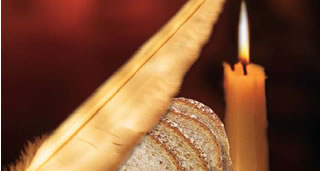
Today, purging, or cleansing the house of all leaven is part of the Passover preparation. Leaven represents sin in our lives. A candle is used to light the search for any leaven, and a feather is used to sweep away any crumbs that might be left behind. Any leaven found is then burned. The candle used represents the light of the LORD that searches the hearts of men:
"Search me, O God, and know my heart;
Try me, and know my thoughts;
And see if there is any wicked way in me,
And lead me in the way everlasting."                   Psalm 139:23-24
                        And
"The spirit of a man is the candle of the LORD,
Searching all the inner depths of his heart."         Prov. 20:27

Paul taught us above, that we are to use this time to examine ourselves by the candle of the Lord, and to rid our lives of old leaven (sin) as we prepare for the Passover. In the same manner, the Bride also prepares herself for the coming marriage supper of the Lamb:
"Let us be glad and rejoice, and give Him glory, for the marriage of the Lamb has come, and His wife has made herself ready (prepared)."                        Rev. 19:7

We are looking for the same miraculous Passover deliverance that comes in a moment, in the twinkling of an eye! (1 Cor. 15:52).

Let us prepare the Passover, and share it together.
                                                                        
And coming early this year….it’s Pesach!
If you would like to celebrate the Passover Seder*, the following links will have some information you will need:


Messianic Passover Haggadah
"Dayenu" Passover Song
"Let My People Go"

*You can also join our Seder, Sat. 4/23/16 at 2 PM, via Skype.

Wednesday, April 6, 2016

Where There's Hope, There's Life

RESURRECTION OUR FAITH AND OUR HOPE
 
The usual expression used is, "Where there's life, there's hope". The expression has been turned around here for this entry title in order to express a truth in scripture, and to find out more about both hope and life.
We are looking at a familiar passage from Ezekiel 37 regarding the prophet's vision of the valley of dry bones. This vision sent by the LORD to Ezekiel can speak many things to us today. If we study the Hebrew word meanings within the verses, we can find needed truth for the Church.
The condition that Ezekiel is shown by the Spirit of the LORD in the valley, is of a great many bones laying about on the ground. These bones were so dry, that they had separated one from another. No flesh or sinew was left to hold them together. One could not tell what bone had been joined to another.
The LORD asks Ezekiel if these bones of the valley can live again. Ezekiel could not see life anywhere. In order to answer the LORD, he said, "O LORD God, You know." (v. 2)
The LORD God begins to speak to the bones, and He instructs Ezekiel to also prophesy to the bones.
As the prophet began to obey and speak to the bones, they began to come together bone to bone (v. 7). Flesh and sinews began to form to cover, join and hold the bones together. The LORD then told the prophet to prophesy the winds of breath to come and breathe upon the bones to give them life. The rejoined bones then stood, alive, to become a great army. The LORD identifies this army as the whole house of Israel.
However, after this great army is given the breath that makes them live again, the LORD tells the prophet that this army is saying something to Him:
"...behold they say, "Our bones are dry and our hope is lost: we are cut off for our parts."
                                                                                   Ez. 37:11b
Although the bones are re-joined and living again miraculously, their cry is one of being without hope, and they still feel that their condition is like dry bones missing parts.
If we look at the Hebrew meaning of the words used in this verse above, it is telling us something very deep, and it explains why the LORD promised them two things in the verses that follow.
According to the Hebrew meanings of the key words of the verse above, this mighty bone army is saying to the LORD that though they are numerous and vast, they are without vital strength. They are ashamed and confused. They still feel like the disjointed bones they were, because there is no cord of hope that binds them together and gives them strength. (The Hebrew meaning for the word "hope" includes the idea of a cord that ties member parts together to make them stronger than they were as separate units). The bone army still feels divided and separated one from another. Needed parts are missing or still separated one from another. This was the Hebrew meaning of their cry to the LORD. There was yet a greater work that needed to be done to strengthen, unify, and make them whole again.
Having heard the bone army's cry, the first promise the LORD made to them was the unifying cord of hope that they lacked. It is the hope of resurrection:
"...Thus says the LORD God, "Behold, O My people (to overshadow and darken because of a huddling together, to collect together, to join together) I will open your graves, and cause you to come up from your graves and bring you into the land of Israel. Then you shall know that I AM the LORD, when I have opened your graves, O My people and brought you up from your graves."                                          Ez. 37:12-13

The New Testament tells us that we have that hope that the dry bones were looking for, that same unifying hope that binds us together with one another like a cord, so we can stand stronger together than if we were just a single individual. That essential, life-giving and unifying hope is found in the resurrection of Jesus Christ:
"Blessed be the God and Father of our Lord Jesus Christ, which according to His abundant mercy hath begotten us again into a lively hope by the resurrection of Jesus Christ from the dead."                                                             1 Peter 1:3
Titus 1:2 tells us that this hope of eternal life was promised by God before the world began. Is it possible that the prophet Ezekiel was taken by the Spirit of the LORD, back to a time before time, and to a place before places were formed, where this promise by the Father was first made, even before the world began? That would be an awesome thing!
This same prophetic promise of resurrection means that even the Church, though seemingly divided into many separate parts, is united by that cord of hope created through the resurrection of Christ from the dead unto eternal life. This is the hope that defines us and holds us together. It is this hope that, though we see the sometimes frightening events of this age, we can "Look up, lift our heads, and see our Redemption drawing nigh" (Lk. 21:28). We can give an answer to others in every circumstance for the hope of the resurrection that is within us (1 Pet. 3:15). It is by this sure and steady promise of hope, that we have the assurance and confidence that we can enter behind the veil into His holy presence (Heb. 6:9). It is this uniting cord of hope that changes us from corruptible into incorruptible (1 Cor. 15:53).
The second promise made at that time by the LORD God in answer to the cry of this revived bone army is a promise of uniting Judah, Israel, and Joseph/Ephraim (added to, doubly fruitful). This is in answer to the statement made by the bones that they are still "cut off (divided, separated) for our parts."
The LORD God promises through the spoken word and action of His prophet to unify two sticks as one (Ez. 37:15-20), to bring back together, to restore, the missing parts that had been cut off. According to the LORD's instructions to Ezekiel, one of the sticks represents Judah and Israel, and the second stick represents Joseph and his son, Ephraim, and the tribes of Israel that are half Gentile.
Again, this concerns the Church, as well as Israel. We are both missing essential parts, those missing parts being each other, that have been cut off and separated from us. We, like the army of living bones, are incomplete without each other.The promise of God is for our unity. By His prophetic Word He has commanded the promise that the two sticks will become one in His hand through the hope found in the resurrection of our Savior and Messiah, Jesus.
This cord of hope in the resurrection of Christ making us a vast, numerous people of God will not, and cannot be broken.

one stick and they will become one in your hand
 
 
Ezek. 37- Two sticks become one in His hand


Thursday, March 31, 2016

Behold, the Lamb of God!


This time of year sees the world celebrating the resurrection of Jesus.
The Gospel of John opens with both a declaration and a depiction that reminds us of the purpose and identity of Jesus:
"The next day John (the Baptist) saw Jesus coming toward him, and said, "Behold, the Lamb of God who takes away the sin of the world!...Again, the next day, John stood with two of his disciples. And looking at Jesus as He walked, he said, "Behold, the Lamb of God!"                                                                             John 1:29-36

The New Testament also closes with both a declaration and depiction of Jesus as the Lamb of God. The angels, elders, and creatures of heaven are declaring loudly:
"Worthy is the Lamb who was slain
To receive power and riches and wisdom,
And strength and honor and glory and blessing!"           Rev. 5:12

"Let us be glad and rejoice and give Him glory, for the marriage of the Lamb has come, and His wife has made herself ready."                                  Rev. 19:7

"The city had no need of the sun or of the moon to shine in it, for the glory of God illuminated it. The Lamb is its light."                               Rev. 21:23

The name of "Lamb" is given to Jesus because on Passover, He was the sacrifice for sin on the cross, and our Father's provision for our deliverance from death. He rose from the dead on the third day after Passover. His association with Passover has a deep importance for His acceptance by the Jewish people, as well as a contextual and spiritual meaning for Gentile people. God decreed the blood of the Passover lamb thousands of years ago in the Torah as He delivered His people from the bondage of the Egyptians. He revealed Passover's prophetic significance in the New Testament/Covenant with Jesus' death on the Passover feast. The term "Passover" in Hebrew includes the meaning of "a sacrifice made that provides a sparing immunity from penalty and calamity". Yet centuries ago, the Church, as a whole, made a decision to separate the sacrificial Lamb of God from the Passover, and instead to calculate the date of His death and the celebration of His Resurrection each year from the date of the Vernal Equinox, the arrival of spring.
This would be error enough, but in addition, by making this change, the Passover Lamb of God has become associated with the goddess Ishtar, with Easter becoming the name given to His day of resurrection. This day is celebrated with new spring outfits, elaborate bonnets, and with cartoonish depictions of bunnies and eggs. While these springtime activities seem harmless enough and pleasant, and provide "fun" for our children, the goddess Ishtar, was a vile, destructive creature. She was the Assyrian/Babylonian goddess of fertility, love, war, and sexual promiscuity. Those whom she chose to "love", were eventually reduced to slavery, and then destruction. Her worshippers would construct tabernacles, or booths (Succothbenoth), of idolatrous prostitution. In her various identities, depending upon the culture, she was considered the personification of the planet Venus. She was not just associated with carnality, but she also carried weapons of war.
Her legend also includes an account of her descent into the Underworld, that should give all Christians serious pause. Ishtar's plan was to violently storm the gates of the Underworld in order to bring the dead back to earth to kill and consume the living. It would be a counterfeit, demonic version of resurrection. Why would we, as Christians, want to be any part of that? Why would we want to associate our Savior with that?  In the beginning, this mixing of Jesus' greatest gift to us with pagan worship was a decision made by the Church that may even have been done with good intentions. However, man should not think that he can change and "improve upon" the will and word of God, especially regarding His beloved Son. Now the tradition is continued perhaps in ignorance. However God gives a strong warning in His word that His people are destroyed from their ignorance and lack of knowledge (Hos. 4:6).
If we remove Jesus, the Lamb, from the delivering power, timing, and deeply prophetic meaning of Passover, which was commanded by God to be taught to all our generations as an everlasting ordinance (Ex. 12:13-14), we lessen the meaning of His resurrection.
The Apostle Paul also exhorted the New Testament Church to observe the true meaning of the Passover:
"Purge out therefore the old leaven, that ye may be a new lump, as ye are unleavened. For even Christ, our Passover, is sacrificed for us. Therefore, let us keep the feast, not with old leaven, neither with the leaven of malice and wickedness; but with the unleavened bread of sincerity and truth.                                    1 Cor. 5:7-8
 
If we associate Jesus' death and resurrection with a pagan goddess instead of the Passover, we have placed a barrier to faith and knowledge of Messiah before the Jewish person, and robbed the Gentile of the full meaning of the crucifixion and resurrection of Christ. We have created a spiritual mixture that does not bring the Lamb the glory He deserves. 
In past examples, as God's people mixed His name with the names of idols, He delivered them into the hands of their enemies, and they suffered the consequences as He removed them out of His sight (2 Kings 17 and 18). By continuing to manipulate the date of the Resurrection, and celebrate it as Easter, we do the same thing, creating the same mixture, by joining the sacred with the profane. 
Jesus certainly did not separate Himself from the Passover. On the night He was arrested:
"... He said unto them, "With desire I have desired to eat this Passover with you before I suffer: For I say unto you, I will not anymore eat thereof, until it be fulfilled in the kingdom of God."                                                        Lk. 22:15-16

With His suffering, death, and resurrection, Jesus fulfilled the Passover, as He, the Lamb of God, was purposed to do. Let us connect the Lamb again with the Passover in our understanding, and in our hearts. He desired and suffered so much to fulfill it on our behalf.


                                                      ... Kosher wine, find the afikoman , and enjoy grub from the old country                             
                                             Above: Matza incl. Afikomen, Unity Bag, cup of wine  


                                                            Above: Seder plate with lamb shank


It was the type, shadow and script of "The Lamb" that rode into town ...
 
Above Depiction: Blood of the Passover Lamb applied to the doorposts and lintels

Thursday, March 17, 2016

Esther, the Beautiful Bride

Esther Queen Of Persia PowerPoint template | Women of the Bible ...
 
 
This is the season of Purim and Resurrection. As we are looking into the Book of Esther, which is the story of Purim, it is rich with revelation and prophetic meaning. It has layers of truth, and the deeper you look, the more layers you can uncover.
One of the beautiful portraits from the Book of Esther is the portrait of the Bride of Christ. Esther was chosen to marry King Ahasuerus. His name translates as "I will be silent and poor (humble)", but even more interestingly, from an older source, his name means "lion-king". His city of Shushan means "lily, trumpet, white" from a root word meaning, "exult, rejoice, leap with joy".
As Esther married the king, she carried two identities. Outwardly, publicly, Esther was a Gentile. However, inwardly and truly, she was a Jew. Her Hebrew birth name was Hadassah, meaning "myrtle". According to rabbinical teaching, the myrtle tree releases a fragrant aroma called "Maharsha" when its leaves are crushed. The leaves were also used in brews and teas for medicinal purposes. The myrtle tree is associated with righteousness as it is mentioned in Zech. 1:8-11.
The name Esther is of Persian origin and means "star". The Hebrew word closest to this name is hester, meaning "hidden". What was hidden about Esther? It was her Jewish identity. This hidden Jewish identity made all the difference in foiling the plot of the wicked Haman against the covenant people of God. Esther's uncle, Mordecai, commanded her not to reveal her Jewish heritage, nor her connection to the Jewish people (Est. 2:10,20). So she lived as a Gentile, known only by her Gentile name.
The Bride of Christ is also both Jewish and Gentile. Although most of the Church is identified as being Gentile, its roots, and its Savior are very much Jewish. Our scriptures are Jewish. The Gentile branches may have been grafted in, but the root is Jewish. Not only that, but scripture tells us that those original Jewish branches are going to be restored.
 
"For if thou wert cut out of the olive tree which is wild by nature,
and wert grafted contrary to nature into a good olive tree:
how much more shall these,
which be the natural branches,
be grafted into their own olive tree?"
 Rom. 11:24
And
"For if their (the Jews) being cast away is the reconciling of the world,
what will their acceptance be but life from the dead?"
Rom. 11:15
 
Queen Esther finally revealed to the king that she was Jewish, as she petitioned the king for her life and for the lives of her people, which were endangered by the plot of Haman (Est. 7:3). While the king originally gave his favor to Esther as a Gentile bride, it is the Jewish bride who came forth from hiding, who broke the plan of the enemy. It is in this moment of her revelation that the king decided the fate of Haman. She was his bride, and he upheld her life, and her royal honor as his wife. 
The Esther story has so many things to teach us. One thing it teaches us, the Church in general, is that if we ignore the importance of the Jewish people as part of the Church identity, and the importance of our Jewish roots, we do so at our own peril, and we will not be able to fulfill properly the role that God has purposed for us in an "Esther victory" over the enemy. That victory is His plan of enlargement and deliverance (Est. 4:14).
Esther is the beautiful Bride of the King. The Bride of Christ is neither Jew nor Gentile (Gal. 3:28, Col. 3:11), but a new creation that requires both identities to be grafted in together, to be made one in His hand, to be all one in Christ Jesus, our King and Bridegroom. It requires the unifying in Him of both identities to become "life from the dead".


Myrtle branches Stock Photos, Images, & Pictures | Shutterstock
photo above: myrtle branch


Wednesday, March 2, 2016

"Prepare Ye the Way of the LORD"


The voice of one crying in the wilderness:
"Prepare ye the way of the LORD; Make straight in the desert a highway for our God. Every valley shall be exalted and every mountain and hill brought low; The crooked places shall be made straight, and the rough places smooth; The glory of the LORD shall be revealed, and all flesh shall see it together; for the mouth of the LORD has spoken."
                                                                       and
"Behold, I send My messenger, and he will prepare the way before Me. And the Lord, whom you seek, will suddenly come to His temple; Even the Messenger of the covenant, in whom you delight. Behold, He is coming," Says the LORD of hosts.      Isa. 40:3-5, Mal. 3:1
 
This above cry comes forth out of the wilderness. If you think of yourself as part of a church that seems to be in a wilderness, it is very likely that this cry is coming from you right now. It is a cry that is calling out to all to "get ready", to prepare. It is a cry that we feel compelled to shout out.
This year, during this season before Passover and Resurrection, it seems especially urgent.
In the days before Passover, a Jewish household is cleansed of leaven, and prepared for the Feast. Similarly, we need to prepare our spiritual houses, ourselves.
The term "prepare" used in the scriptures above refers to a "turning back, a turning toward something, and a turning away from something, an approach of evening, to clear from things in confusion, to put a house in order, to face, to approach, to behold."
The "way" that we are to prepare as used above, is a journey, a road, a manner, a conversation, a custom, a way of life. Most interestingly, it also means to express wine or oil by treading down with the feet. Wine and oil have great meaning in God's Kingdom, one of which is their use in comfort and healing. In the parable of the Good Samaritan, the Samaritan uses wine and oil to bring healing to the wounds of the man he finds beaten while the Samaritan is on his journey (way) in Lk. 10:33-34.
 
 
                                            Olive Oil | Beyond Health NewsClips

Oil is also used to represent the Holy Spirit, and the anointing and presence of the LORD. The oil is used to light lamps, including the Lamp of the LORD in the Temple.
Jesus pointed out that not only were we to be a light, but a light by which all can see through the darkness. That light is to be lifted up, placed on a lampstand, that those who enter may see it, in order to relieve that darkness, and bring glory to God:
"You are the light of the world. A city that is set on a hill cannot be hidden. Nor do they light a lamp, and put it under a basket, but on a lampstand, and it gives light to all who are in the house...that those who enter may see the light... Let your light so shine before men, that they may see your good works, and glorify your Father in heaven."      Mt. 5:14-16, Lk. 8:16
Jesus warns us about being unprepared, caught without oil in our lamps, when the bridegroom suddenly comes, with a shout, or a cry:

"And at midnight a cry was heard: "Behold, the bridegroom is coming; go out to meet him!" Then all those virgins arose and trimmed their lamps. And the foolish said to the wise, "Give us some of your oil, for our lamps are going out"...And while they went to buy, the bridegroom came, and those who were ready went in with him to the wedding, and the door was shut."                Mt. 25:6-10 (abridged)


The wine produced by preparing the way of the LORD is a symbol of the blood, the atonement of Christ, the redemption, the reconciliation, the beautiful new covenant between God and man. It is also a symbol of the gladness of the LORD. It is the miracle done at the wedding in Cana. ("Cana" happens to have the root meaning of a measuring rod, the beam of a balancing scale, the shaft and branches of a lampstand)
In the treading down process, the way that belongs to the LORD presses the oil out of the olive, and the wine from the grapes. This is what is to be pressed from our lives also. We turn back to those things of God that allow the oil and the wine to come forth from us. Jesus called Himself The Way. He is the One who produces this oil and wine from each one of us, if we will submit to Him in this pressing process.
The cry is going out from the wilderness: Now is the time to prepare, now is the time to have our lamps filled with the oil which is produced from the way of the LORD. Now is the time to have that light in us shining for all to see the way out of the darkness, and into His marvelous light. Let our temple storehouses be filled with the oil and the wine of the Spirit. It is time to make our crooked places straight, to raise up the valleys in our lives, and pull down those mountains that have exalted themselves in us, to smooth out those rough places, to prepare His way. All of these "preparations" have a direct impact on the soon and sudden coming of the Lord, according to our scriptures above. 
As we prepare the way before Him, He will enter in.